The world in 400 BC
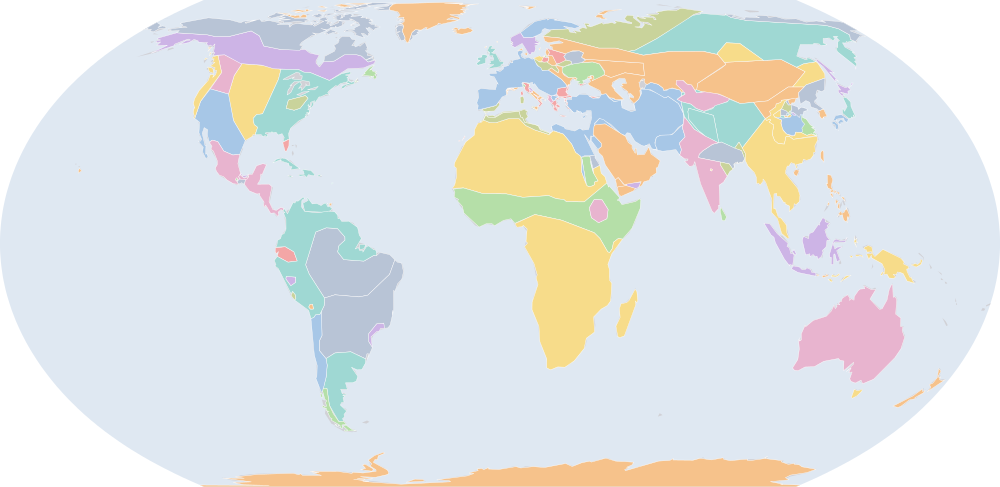
On 1 July 400 BC, IntMap’s historical map draws 105 names across the world. The borders for this date come from Cliopatria, Seshat Global History Databank (by year), then historical-basemaps — each drawn only where the records before it are silent. It also draws 111 outlines whose name the record does not give for this date.
Why this year has a page
The historical-basemaps atlas drew a world sheet for this year.
Names on the map
As the map labels them, largest first by the area of the outline drawn. Areas are of the drawn outline, rounded, and approximate. The record column says which record draws the outline; a Wikidata item is given where the record links one.
| Name | Record | Drawn area (km²) |
|---|---|---|
| Khoiasan | historical-basemaps | 11,700,000 |
| Saharan Pastoral Nomads | historical-basemaps | 10,000,000 |
| Australian aboriginal hunter-gatherers (a description by the source, not a name) | historical-basemaps | 7,600,000 |
| Paleo-Siberian hunter-gatherers (a description by the source, not a name) | historical-basemaps | 6,970,000 |
| Achaemenid Empire | Cliopatria · historical-basemaps Q389688 | 6,220,000 |
| West African cereal farmers (a description by the source, not a name) | historical-basemaps | 6,030,000 |
| Arctic marine mammal hunters (a description by the source, not a name) | historical-basemaps | 5,910,000 |
| Manioc farmers (a description by the source, not a name) | historical-basemaps | 4,840,000 |
| Savanna hunter-gatherers (a description by the source, not a name) | historical-basemaps | 4,820,000 |
| Subarctic forest hunter-gatherers (a description by the source, not a name) | historical-basemaps | 4,330,000 |
| Amazon hunter-gatherers (a description by the source, not a name) | historical-basemaps | 4,280,000 |
| Austro-Asiatic rice farmers (a description by the source, not a name) | historical-basemaps | 3,990,000 |
| Finno-Ugric taiga hunter-gatherers (a description by the source, not a name) | historical-basemaps | 3,530,000 |
| Eastern North Amercian hunter-gatherers (a description by the source, not a name) | historical-basemaps | 3,320,000 |
| Plain bison hunters (a description by the source, not a name) | historical-basemaps | 2,850,000 |
| Celltic Hallsatt culture (a description by the source, not a name) | historical-basemaps | 2,380,000 |
| Proto-Tibetan cultures (a description by the source, not a name) | historical-basemaps | 2,370,000 |
| Desert hunter-gatherers (a description by the source, not a name) | historical-basemaps | 2,350,000 |
| Hindu kingdoms (a description by the source, not a name) | historical-basemaps | 2,120,000 |
| Pampas cultures (a description by the source, not a name) | historical-basemaps | 1,830,000 |
| Maize farmers (a description by the source, not a name) | historical-basemaps | 1,550,000 |
| Austronesians | historical-basemaps | 1,430,000 |
| Warring States China | Cliopatria | 1,000,000 |
| Yuezhi | Cliopatria Q467985 | 915,000 |
| Papuan neolithic farmers (a description by the source, not a name) | historical-basemaps | 884,000 |
| Mahajanapadas | Cliopatria Q846025 | 804,000 |
| Magadha - Shaishunaga dynasty | Cliopatria Q972165 | 799,000 |
| Andean hunter-gatherers (a description by the source, not a name) | historical-basemaps | 744,000 |
| Scythia | Cliopatria | 730,000 |
| Scythians | historical-basemaps | 729,000 |
| Plateau fichers and hunter gatherers (a description by the source, not a name) | historical-basemaps | 722,000 |
| Zhangzhung Kingdom | historical-basemaps | 664,000 |
| Proto-Altaic pastoralists (a description by the source, not a name) | historical-basemaps | 663,000 |
| Saami | historical-basemaps | 631,000 |
| Zhou states (a description by the source, not a name) | historical-basemaps | 601,000 |
| Proto-Thai cultures (a description by the source, not a name) | historical-basemaps | 592,000 |
| Gojoseon | historical-basemaps | 539,000 |
| Donghu tribes (a description by the source, not a name) | historical-basemaps | 538,000 |
| North American Pacifi foraging, hunting and fishing peoples | historical-basemaps | 533,000 |
| Caribbean hunter-gatherers (a description by the source, not a name) | historical-basemaps | 513,000 |
| Carthaginian Empire | historical-basemaps | 451,000 |
| Chu | Cliopatria Q504759 | 390,000 |
| Germanic tribes (a description by the source, not a name) | historical-basemaps | 376,000 |
| Ethiopian highland farmers (a description by the source, not a name) | historical-basemaps | 376,000 |
| Kingdom of Kush | Cliopatria Q241790 | 337,000 |
| Celts | historical-basemaps | 289,000 |
| Chorrera | historical-basemaps | 262,000 |
| Patagonian shellfish and marine mammal hunters (a description by the source, not a name) | historical-basemaps | 259,000 |
| Plain-Pottery culture (a description by the source, not a name) | historical-basemaps | 232,000 |
| Adena Culture | historical-basemaps | 225,000 |
All 105 names
| Name | Record | Drawn area (km²) |
|---|---|---|
| Carthage | Cliopatria Q2429397 | 205,000 |
| Yue | Cliopatria Q1936158 | 186,000 |
| Brushed Pottery culture (a description by the source, not a name) | historical-basemaps | 184,000 |
| Greek City-States | Cliopatria | 174,000 |
| Late Jomon culture (a description by the source, not a name) | historical-basemaps | 167,000 |
| Magadha | historical-basemaps | 166,000 |
| Bell-shaped burials culture (a description by the source, not a name) | historical-basemaps | 159,000 |
| Ainu | historical-basemaps | 159,000 |
| Shellfish gatherers (a description by the source, not a name) | historical-basemaps | 149,000 |
| Qi | Cliopatria Q837855 | 120,000 |
| Yayoi | historical-basemaps | 113,000 |
| Paleo-Inuit | historical-basemaps | 112,000 |
| Odrysian Kingdom | Cliopatria Q870517 | 105,000 |
| Blemmyes | historical-basemaps | 88,900 |
| Hadhramaut | Cliopatria Q1517159 | 86,200 |
| Chavin | historical-basemaps | 82,900 |
| Wei | Cliopatria Q912052 | 79,300 |
| Eastern Masurian culture (a description by the source, not a name) | historical-basemaps | 74,500 |
| Milograd culture | historical-basemaps | 73,900 |
| Etruscans | Cliopatria Q17161 | 65,200 |
| Sabaeans | Cliopatria Q940785 | 64,200 |
| Simhala | historical-basemaps | 62,000 |
| Tasmanian hunter-gatherers (a description by the source, not a name) | historical-basemaps | 59,400 |
| Glades Culture | historical-basemaps | 59,100 |
| Macedonian Empire | Cliopatria Q83958 | 58,300 |
| Zhao | Cliopatria Q197430 | 57,600 |
| Greek colonies | historical-basemaps | 53,700 |
| Kush | historical-basemaps | 46,900 |
| Qin | Cliopatria Q34756 | 46,400 |
| Greek city-states (a description by the source, not a name) | historical-basemaps | 45,900 |
| Pomeranian culture | historical-basemaps | 44,400 |
| Yan | Cliopatria Q1055713 | 39,300 |
| Zapotec | historical-basemaps | 34,900 |
| Song | Cliopatria Q1065073 | 34,100 |
| Western Masurian culture (a description by the source, not a name) | historical-basemaps | 32,600 |
| Olmec | historical-basemaps | 31,800 |
| Paracas | historical-basemaps | 29,500 |
| Peloponnesian League | Cliopatria Q208742 | 22,900 |
| Curonians | historical-basemaps | 21,700 |
| Wankarani | historical-basemaps | 19,700 |
| Han | Cliopatria | 18,500 |
| Olmec Civilization | Cliopatria | 17,700 |
| Boii | historical-basemaps | 11,600 |
| Etrurians | historical-basemaps | 10,900 |
| Zheng | Cliopatria Q197598 | 10,200 |
| Samnites | historical-basemaps | 9,160 |
| Guanches | historical-basemaps | 9,080 |
| Lu | Cliopatria Q736936 | 8,950 |
| Roman Republic | Cliopatria · historical-basemaps Q17167 | 8,520 |
| Sambian-Nothangian culture (a description by the source, not a name) | historical-basemaps | 8,310 |
| Sabini | historical-basemaps | 7,840 |
| Zapotec Civilization | Cliopatria | 6,470 |
| Wey | Cliopatria Q1147897 | 5,800 |
| Janapada of Aśmaka | Cliopatria Q1194906 | 5,420 |
| Cimmerian Bosporus | Cliopatria Q321371 | 1,960 |
What changed since 500 BC
Names counted are those the records date to the year or the day (CShapes, OpenHistoricalMap, Cliopatria). Outlines filled from the nearest historical-basemaps sheet are counted only when both years are years that sheet was drawn for — otherwise the change would be the switch between two sheets, not a change in the world. Names are compared as written, so a polity a record names differently in the two years (Carthaginian Empire, then Carthage) is in both lists.
Now drawn (24)
Austro-Asiatic rice farmers, Celltic Hallsatt culture, Proto-Tibetan cultures, Warring States China, Yuezhi, Magadha - Shaishunaga dynasty, Scythians, Zhangzhung Kingdom, Proto-Thai cultures, Gojoseon, Donghu tribes, Germanic tribes, Celts, Yayoi, Odrysian Kingdom, Wei, Zhao, Greek colonies, Kush, Zapotec, Paracas, Wankarani, Han, Cimmerian Bosporus
No longer drawn (36)
Iron Age megalith cultures, Spring and Autumn States, Illyrians, Wu, El Paraiso, Jin, Pancala, Kuru, Saba, Avanti, Meroe, Chinchoros, Surasena, Magadha - Haryanka dynasty, Kosala, Gandhāra, Kasi, Zhu, Janapada of Malla, Janapada of Kuru, Janapada of Matsya, Janapada of Surasena, Janapada of Vajji, Malla, Janapada of Avanti, Chen, Janapada of Kāśī, Janapada of Kosala, Janapada of Pañcāla, Janapada of Cedī, Teng, Janapada of Vatsa, Cao, Cai, Vatsa, Rome
Events dated to 400 BC
The index of dated events holds no event for 400 BC.
Sources and method
Borders and names: Cliopatria v0.2.1 (Seshat Global History Databank, github.com/Seshat-Global-History-Databank/cliopatria) · CC BY 4.0 · adapted by IntMap: simplified, BC years made astronomical, and the ground OpenHistoricalMap (1689–1885, and from 1886 where CShapes is silent) and CShapes (1886–2019) state removed on their own dates + aourednik/historical-basemaps (github.com/aourednik/historical-basemaps) · GPL-3.0 · adapted by IntMap: each sheet before 1886 less the ground OpenHistoricalMap and Cliopatria state at that sheet's year.
Which years have a page is worked out when the site is built, from three rules applied to the records themselves: every year the historical-basemaps atlas drew a world sheet for; every year whose change from the year before (names the dated records begin or stop drawing) is in the top 5% of all such year-to-year changes since the dated records begin, leaving out the years where one record hands over to another; and every year of a geopolitical, war or revolution event in the dated events index, up to the last year the border records cover (2019).
On each year the map is read on 1 July, the instant the app’s own year links open on. Names are the source’s own, translated where the source or IntMap’s name table has a translation. A name is what a record draws there, not a verdict of history.
World map in 400 BC — the map, with the years it stays the same Historical maps by region Countries On this day