The world in 100 BC
On 1 July 100 BC, IntMap’s historical map draws 111 names across the world. The borders for this date come from Cliopatria, Seshat Global History Databank (by year), then historical-basemaps — each drawn only where the records before it are silent. It also draws 109 outlines whose name the record does not give for this date.
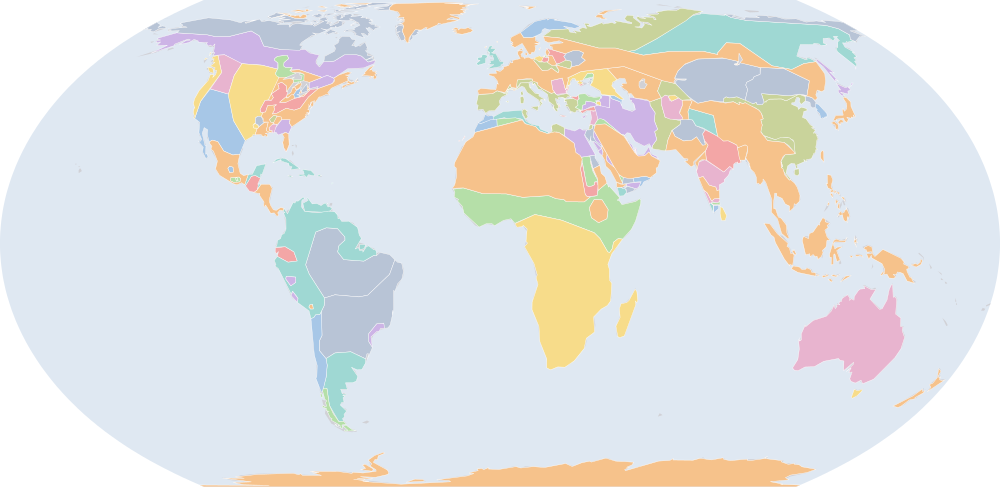
Why this year has a page
The historical-basemaps atlas drew a world sheet for this year.
Names on the map
As the map labels them, largest first by the area of the outline drawn. Areas are of the drawn outline, rounded, and approximate. The record column says which record draws the outline; a Wikidata item is given where the record links one.
| Name | Record | Drawn area (km²) |
|---|---|---|
| Khoiasan | historical-basemaps | 11,700,000 |
| Australian aboriginal hunter-gatherers (a description by the source, not a name) | historical-basemaps | 7,600,000 |
| Paleo-Siberian hunter-gatherers (a description by the source, not a name) | historical-basemaps | 7,170,000 |
| West African cereal farmers (a description by the source, not a name) | historical-basemaps | 6,000,000 |
| Arctic marine mammal hunters (a description by the source, not a name) | historical-basemaps | 5,910,000 |
| Xiongnu | Cliopatria · historical-basemaps Q188836 | 5,090,000 |
| Manioc farmers (a description by the source, not a name) | historical-basemaps | 4,830,000 |
| Savanna hunter-gatherers (a description by the source, not a name) | historical-basemaps | 4,820,000 |
| Amazon hunter-gatherers (a description by the source, not a name) | historical-basemaps | 4,280,000 |
| Subarctic forest hunter-gatherers (a description by the source, not a name) | historical-basemaps | 4,130,000 |
| Finno-Ugric taiga hunter-gatherers (a description by the source, not a name) | historical-basemaps | 3,530,000 |
| Han Dynasty | Cliopatria Q7209 | 3,160,000 |
| Plain bison hunters (a description by the source, not a name) | historical-basemaps | 2,790,000 |
| Desert hunter-gatherers (a description by the source, not a name) | historical-basemaps | 2,350,000 |
| Parthian Empire | Cliopatria Q1986139 | 2,190,000 |
| Pampas cultures (a description by the source, not a name) | historical-basemaps | 1,830,000 |
| Roman Republic | Cliopatria · historical-basemaps Q17167 | 1,340,000 |
| Scythians | historical-basemaps | 1,170,000 |
| Shunga Empire | Cliopatria Q651377 | 1,100,000 |
| Indo-Scythians | Cliopatria Q240123 | 861,000 |
| Sarmates | historical-basemaps | 792,000 |
| Hopewell Culture | historical-basemaps | 779,000 |
| Andean hunter-gatherers (a description by the source, not a name) | historical-basemaps | 744,000 |
| Plateau fichers and hunter gatherers (a description by the source, not a name) | historical-basemaps | 722,000 |
| Satavahana Dynasty | Cliopatria Q5257 | 660,000 |
| Saami | historical-basemaps | 631,000 |
| Indo-Greeks | Cliopatria Q215643 | 597,000 |
| Ptolemaic Kingdom | Cliopatria · historical-basemaps Q2320005 | 575,000 |
| North American Pacifi foraging, hunting and fishing peoples | historical-basemaps | 533,000 |
| Caribbean hunter-gatherers (a description by the source, not a name) | historical-basemaps | 513,000 |
| Zhangzhung Kingdom | historical-basemaps | 503,000 |
| Yuezhi | Cliopatria Q467985 | 461,000 |
| Saces | historical-basemaps | 406,000 |
| Laurel complex | historical-basemaps | 368,000 |
| Han Empire | historical-basemaps | 357,000 |
| Kingdom of Kush | Cliopatria Q241790 | 337,000 |
| Kingdom of Numidia | Cliopatria | 309,000 |
| Celts | historical-basemaps | 289,000 |
| Meroe | historical-basemaps | 278,000 |
| Mauretania | Cliopatria · historical-basemaps Q309272 | 268,000 |
| Chorrera | historical-basemaps | 262,000 |
| Patagonian shellfish and marine mammal hunters (a description by the source, not a name) | historical-basemaps | 259,000 |
| Plain-Pottery culture (a description by the source, not a name) | historical-basemaps | 258,000 |
| Point Peninsula | historical-basemaps | 244,000 |
| Daces | historical-basemaps | 222,000 |
| Swift Creek Culture | historical-basemaps | 222,000 |
| Minaeans | Cliopatria | 215,000 |
| Kingdom of Pontus | Cliopatria Q7380487 | 214,000 |
| Mayan City-States | Cliopatria Q28567 | 199,000 |
| Brushed Pottery culture (a description by the source, not a name) | historical-basemaps | 184,000 |
All 111 names
| Name | Record | Drawn area (km²) |
|---|---|---|
| Maya chiefdoms and states (a description by the source, not a name) | historical-basemaps | 169,000 |
| Bell-shaped burials culture (a description by the source, not a name) | historical-basemaps | 159,000 |
| Ainu | historical-basemaps | 159,000 |
| Shellfish gatherers (a description by the source, not a name) | historical-basemaps | 149,000 |
| Marksville Culture | historical-basemaps | 149,000 |
| Numidia | historical-basemaps | 143,000 |
| Kingdom of Armenia | Cliopatria Q208404 | 132,000 |
| Nabataeans | Cliopatria Q220594 | 127,000 |
| Qataban | Cliopatria · historical-basemaps Q748595 | 124,000 |
| Cyrenaica | Cliopatria Q165198 | 117,000 |
| Korean Jin | Cliopatria Q1155101 | 113,000 |
| Seleucid Kingdom | historical-basemaps | 112,000 |
| Hadramaut | historical-basemaps | 98,100 |
| Milograd culture | historical-basemaps | 97,800 |
| Seleucid Empire | Cliopatria Q705904 | 91,700 |
| Nabatean Kingdom | historical-basemaps | 90,400 |
| Greek City-States | Cliopatria | 89,500 |
| Blemmyes | historical-basemaps | 88,900 |
| Kingdom of Cappadocia | Cliopatria Q29654286 | 88,700 |
| Hadhramaut | Cliopatria Q1517159 | 86,500 |
| Chavin | historical-basemaps | 82,900 |
| Gojoseon | Cliopatria Q28405 | 81,300 |
| Eastern Masurian culture (a description by the source, not a name) | historical-basemaps | 74,500 |
| Anurādhapura | Cliopatria Q5724 | 74,200 |
| Himyarite Kingdom | Cliopatria Q289577 | 73,900 |
| Hindu kingdoms (a description by the source, not a name) | historical-basemaps | 71,200 |
| Fourche Maline Culture | historical-basemaps | 70,600 |
| minor states (a description by the source, not a name) | historical-basemaps | 66,700 |
| Maan | historical-basemaps | 63,300 |
| Tasmanian hunter-gatherers (a description by the source, not a name) | historical-basemaps | 59,400 |
| Glades Culture | historical-basemaps | 58,600 |
| Monte Albán | historical-basemaps | 57,100 |
| Bosporan Kingdom | historical-basemaps | 52,900 |
| Couture Complex | historical-basemaps | 51,800 |
| Great Yuan | Cliopatria | 50,900 |
| Porter | historical-basemaps | 50,700 |
| Goodall Focus | historical-basemaps | 50,300 |
| Copena | historical-basemaps | 46,600 |
| Pomeranian culture | historical-basemaps | 44,400 |
| Miller | historical-basemaps | 44,300 |
| Nazca | historical-basemaps | 41,900 |
| Teotihuacán | historical-basemaps | 40,700 |
| Sabaeans | Cliopatria Q940785 | 35,300 |
| Early Pandyas | Cliopatria | 32,700 |
| Western Masurian culture (a description by the source, not a name) | historical-basemaps | 32,600 |
| Saugeen Complex | historical-basemaps | 32,600 |
| Kingdom of Bithynia | Cliopatria Q3762571 | 30,000 |
| Early Cholas | Cliopatria Q3532146 | 29,000 |
| Early Cheras | Cliopatria | 25,500 |
| Mill Creek Culture | historical-basemaps | 25,400 |
| Cimmerian Bosporus | Cliopatria Q321371 | 25,000 |
| Arakan | historical-basemaps | 23,700 |
| Curonians | historical-basemaps | 21,700 |
| Wankarani | historical-basemaps | 19,700 |
| Saba | historical-basemaps | 18,400 |
| Kingdom of Sophene | Cliopatria Q2626105 | 16,800 |
| Judea | Cliopatria Q104028 | 15,600 |
| Guanches | historical-basemaps | 9,080 |
| Sambian-Nothangian culture (a description by the source, not a name) | historical-basemaps | 8,310 |
| Zapotec Civilization | Cliopatria | 6,470 |
| Parthia | historical-basemaps | 128 |
What changed since 200 BC
Names counted are those the records date to the year or the day (CShapes, OpenHistoricalMap, Cliopatria). Outlines filled from the nearest historical-basemaps sheet are counted only when both years are years that sheet was drawn for — otherwise the change would be the switch between two sheets, not a change in the world. Names are compared as written, so a polity a record names differently in the two years (Carthaginian Empire, then Carthage) is in both lists.
Now drawn (31)
Shunga Empire, Indo-Scythians, Sarmates, Hopewell Culture, Indo-Greeks, Saces, Laurel complex, Kingdom of Numidia, Point Peninsula, Daces, Swift Creek Culture, Marksville Culture, Numidia, Kingdom of Armenia, Nabataeans, Cyrenaica, Korean Jin, Gojoseon, Himyarite Kingdom, Hindu kingdoms, Fourche Maline Culture, Couture Complex, Great Yuan, Porter, Goodall Focus, Copena, Miller, Nazca, Saugeen Complex, Mill Creek Culture, Judea
No longer drawn (38)
Saharan Pastoral Nomads, Eastern North Amercian hunter-gatherers, Thai, Arabs, Turcik tribes, Malays, Mauryan Empire, Mon-Khmer, Maurya Empire, Papuan, Tungus, Bactria, Maize farmers, Greco-Bactrian Kingdom, Norsemen, Nanyue, Minyue, Adena Culture, Rome, Carthage, Atropatene, Kingdom of Syphax, Antigonid Macedonia, Kalinga, Iron Age chieftainships, Galatia, Kingdom of Pergamon, Macedon and Hellenic League, Nan-Yue, Paracas, Kingdom of Gala, ?, Paphlagonia, Dardania, Achaean League, Aetolian League, Pergamon, Min-Yue
Events dated to 100 BC
The index of dated events holds no event for 100 BC.
Sources and method
Borders and names: Cliopatria v0.2.1 (Seshat Global History Databank, github.com/Seshat-Global-History-Databank/cliopatria) · CC BY 4.0 · adapted by IntMap: simplified, BC years made astronomical, and the ground OpenHistoricalMap (1689–1885, and from 1886 where CShapes is silent) and CShapes (1886–2019) state removed on their own dates + aourednik/historical-basemaps (github.com/aourednik/historical-basemaps) · GPL-3.0 · adapted by IntMap: each sheet before 1886 less the ground OpenHistoricalMap and Cliopatria state at that sheet's year.
Which years have a page is worked out when the site is built, from three rules applied to the records themselves: every year the historical-basemaps atlas drew a world sheet for; every year whose change from the year before (names the dated records begin or stop drawing) is in the top 5% of all such year-to-year changes since the dated records begin, leaving out the years where one record hands over to another; and every year of a geopolitical, war or revolution event in the dated events index, up to the last year the border records cover (2019).
On each year the map is read on 1 July, the instant the app’s own year links open on. Names are the source’s own, translated where the source or IntMap’s name table has a translation. A name is what a record draws there, not a verdict of history.
World map in 100 BC — the map, with the years it stays the same Historical maps by region Countries On this day